

- English
 Esperanto
 Afrikaans
 Català
 שפה עברית
 Cymraeg
 Galego
 Latviešu
 icelandic
 ייִדיש
 беларускі
 Hrvatski
 Kreyòl ayisyen
 Shqiptar
 Malti
Malti lugha ya Kiswahili
 አማርኛ
አማርኛ Bosanski
 Frysk
Frysk ភាសាខ្មែរ
 ქართული
 ગુજરાતી
 Hausa
Hausa Кыргыз тили
 ಕನ್ನಡ
ಕನ್ನಡ Corsa
Corsa Kurdî
Kurdî മലയാളം
 Maori
Maori Монгол хэл
 Hmong
Hmong IsiXhosa
 Zulu
Zulu Punjabi
 پښتو
پښتو Chichewa
 Samoa
Samoa Sesotho
 සිංහල
සිංහල Gàidhlig
 Cebuano
 Somali
 Тоҷикӣ
 O'zbek
 Hawaiian
 سنڌي
سنڌي Shinra
 Հայերեն
 Igbo
Igbo Sundanese
 Lëtzebuergesch
 Malagasy
 Yoruba
 অসমীয়া
 ଓଡିଆ
ଓଡିଆ Español
 Português
 русский
 Français
 日本語
日本語 Deutsch
 tiếng Việt
 Italiano
 Nederlands
 ภาษาไทย
 Polski
 한국어
한국어 Svenska
 magyar
 Malay
Malay বাংলা ভাষার
 Dansk
Dansk Suomi
Suomi हिन्दी
 Pilipino
 Türkçe
 Gaeilge
 العربية
 Indonesia
 Norsk
Norsk تمل
تمل český
český ελληνικά
 український
 Javanese
 فارسی
فارسی தமிழ்
தமிழ் తెలుగు
 नेपाली
 Burmese
 български
 ລາວ
ລາວ Latine
 Қазақша
 Euskal
 Azərbaycan
 Slovenský jazyk
 Македонски
 Lietuvos
 Eesti Keel
 Română
 Slovenski
 मराठी
मराठी Srpski језик

How Advanced Concrete Block Moulds Improve Concrete Block Surface Quality?
In the competitive landscape of modern construction and hardscaping, the visual appeal and structural integrity of concrete blocks are no longer optional—they are baseline requirements. A flawless, uniform surface finish directly translates to higher market value, reduced installation costs, and enhanced customer trust. The unsung hero behind this quality leap is the evolution of concrete block moulds. Gone are the days of rough edges, inconsistent textures, and costly post-processing. Today, advanced precision-engineered moulds redefine what is possible, merging metallurgical science with micron-level accuracy to deliver blocks that meet the most stringent architectural standards. For two decades, we at Quangong Machinery Co., Ltd. have observed how the right mould tooling becomes the difference between average output and superior, sale-ready products.
But what exactly makes a mould "advanced," and how does it tangibly upgrade surface quality? This guide dissects the engineering principles, material innovations, and design philosophies that set high-performance Concrete Block Moulds apart. Whether you are aiming to eliminate surface pitting, achieve glass-like finishes on pavers, or guarantee consistent texture across millions of cycles, understanding these parameters is crucial. Our factory integrates German-engineered machining centers and proprietary heat treatment protocols to produce moulds that not only extend service life but also elevate every single block's surface to a premium standard. Read on to explore how precision tooling directly answers the industry’s most demanding aesthetic and durability challenges.
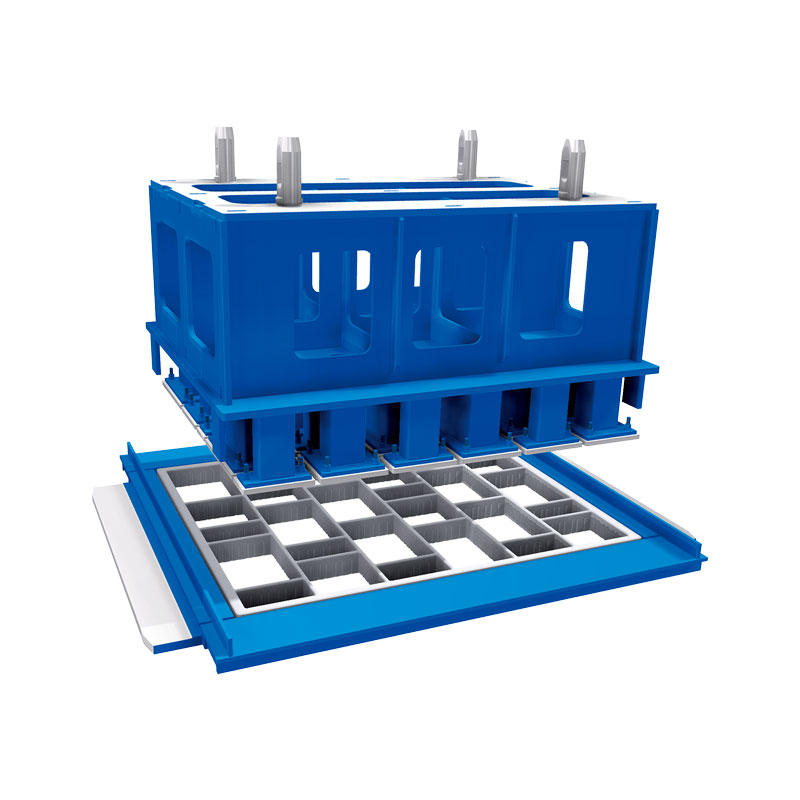
Table of Contents
- 1. What Specific Parameters Define Advanced Concrete Block Moulds for Superior Surface Quality?
- 2. Why Does Micro-Precision Machining Eliminate Common Surface Defects in Concrete Blocks?
- 3. How Do Material Selection and Heat Treatment Protocols Prolong Mould Life and Maintain Surface Finish?
- 4. Which Design Innovations in Venting and Demolding Systems Prevent Surface Blemishes?
- 5. Conclusion: Investing in Advanced Moulds as a Quality Assurance Strategy
- 6. Frequently Asked Questions (FAQ) – Advanced Concrete Block Moulds & Surface Excellence
1. What Specific Parameters Define Advanced Concrete Block Moulds for Superior Surface Quality?
The journey to immaculate concrete block surfaces begins with quantifiable mould parameters that go far beyond basic dimensions. At Quangong Machinery Co., Ltd., our engineering team treats each mould as a precision instrument. Advanced Concrete Block Moulds are characterized by four critical pillars: dimensional accuracy, surface finish of the cavity, geometric tolerances, and wear-resistant coatings. When these parameters are optimized, the resulting concrete blocks exhibit minimal variance, sharp edges, and a consistent face texture that requires no additional grinding or coating.
Below is a detailed breakdown of the core parameters that our factory integrates into every mould system. These specifications directly correlate with the elimination of common defects such as honeycombing, burrs, and uneven color absorption.
| Parameter Category | Advanced Specification & Impact on Surface Quality |
| Cavity Surface Roughness (Ra) | ≤ 0.4 µm (mirror-like finish). This ultra-smooth cavity prevents concrete paste adhesion, reducing micro-pitting and ensuring a glossy, easy-to-release surface on every block. Standard moulds often have Ra >1.6 µm, leading to drag marks. |
| Dimensional Tolerance (mm) | ±0.05 mm on all critical dimensions. Tight tolerances ensure that mating surfaces (shoes, cores) align perfectly, preventing flash or stepped edges which degrade the block’s aesthetic uniformity and stacking ability. |
| Hardness (HRC) | 58–62 HRC after deep cryogenic treatment. Higher hardness resists abrasive aggregates from scratching the cavity walls, preserving the initial surface finish across 100,000+ cycles. |
| Chrome Layer Thickness (if applicable) | 20–25 µm hard chrome with micro-crack distribution. This reduces friction during demolding by 40%, eliminating scoring lines and delivering consistently smooth block faces. |
| Vent Slot Geometry | Laser-cut vents with tapered profile (0.15mm–0.5mm). Proper venting releases trapped air without allowing cement paste to escape, thus preventing blowholes and surface craters. |
| Base Plate Flatness | ≤0.03 mm across the entire plate. Absolute flatness ensures uniform pressure distribution during vibration, directly responsible for eliminating warping and uneven top surfaces. |
These parameters are not arbitrary numbers; they represent the cumulative knowledge gained from analyzing millions of blocks produced in our factory and partner facilities. For instance, the cavity roughness threshold of 0.4 µm is derived from tribology studies showing that below this point, the friction coefficient between the mould steel and semi-dry concrete drops exponentially. This means the block releases with less mechanical stress, preserving the integrity of the surface microstructure. Additionally, our Concrete Block Moulds utilize multi-stage stress-relieving processes before final machining to ensure that even after thousands of heating and cooling cycles, the tooling retains its original geometry. When a block producer invests in such parameter-controlled moulds, they are effectively buying a guarantee: every block will mirror the mould’s precision, delivering a surface quality that speaks of professionalism and durability.
Beyond the numbers, our factory emphasizes traceability. Each set of Concrete Block Moulds is accompanied by a CMM (Coordinate Measuring Machine) report, validating that every cavity meets the promised specifications. This level of transparency assures our clients that the surface finish of their blocks will not degrade due to tooling inconsistencies. Ultimately, advanced parameters turn the mould from a passive container into an active quality-enhancing tool.
2. Why Does Micro-Precision Machining Eliminate Common Surface Defects in Concrete Blocks?
Surface defects such as pinholes, edge fragility, and inconsistent texture are often erroneously attributed to concrete mix design alone. However, in our two decades of specialized manufacturing at Quangong Machinery Co., Ltd., we have identified that the root cause frequently lies in the machining precision of the mould itself. Micro-precision machining—a process where computer-controlled grinding, EDM (Electrical Discharge Machining), and high-speed milling achieve sub-micron accuracy—directly eliminates the mechanical origins of defects. The difference between a standard mould and an advanced one is visible under magnification: the latter exhibits perfectly blended radii, burr-free parting lines, and flawless draft angles.
Here is a structured list of how micro-precision machining attacks and neutralizes specific surface defects:
- Elimination of Burrs and Sharp Transitions: Using wire EDM with a tolerance of ±0.005 mm ensures that all edges are either perfectly sharp (for splitter lines) or properly radiused. Burrs on mould edges act as stress concentrators, causing micro-cracks along block edges during demolding. Our factory’s post-machining deburring and electropolishing steps guarantee that block edges are crisp yet free from stress fractures.
- Uniform Cavity Finish to Prevent Paste Adhesion: Micro-polishing with diamond abrasives yields a homogeneous cavity surface. In contrast, conventional machining leaves directional tool marks that act as anchors for cement paste. When the block is stripped, these paste residues tear away portions of the surface, creating visible drag lines. Our precision-ground cavities present a non-directional finish that allows the block to release cleanly every cycle.
- Consistent Draft Angles for Even Demolding: Draft angles (typically 1.5° to 2.5°) are machined with micro-consistency across all cavities. Even a 0.1° variation can cause uneven extraction forces, leading to one side of the block being scuffed while the other releases easily. By maintaining exact draft angles, we ensure that the entire block surface exits the mould with uniform friction, preserving the intended texture and color consistency.
- Zero-Compromise Cavity Alignment: Multi-cavity moulds require perfect alignment between the core and the cavity plate. Micro-precision machining uses dowel pins with positional accuracy of ±0.01 mm. Misalignment as small as 0.1 mm can produce stepped sidewalls or uneven wall thickness, which are immediate aesthetic failures. Our CNC-controlled boring and jig grinding guarantee that each block’s side surfaces are perfectly planar and co-planar with adjacent blocks.
- Enhanced Surface Texture Replication: For textured blocks (e.g., tumbled, ashlar, or wood-grain), micro-precision machining allows for the reproduction of texture depths with an accuracy of ±0.03 mm. This ensures that the pattern is uniform across the entire block face and repeatable across thousands of cycles, eliminating faded or patchy textural effects.
Our investment in 5-axis machining centers and laser scanners is not merely about capability—it is about delivering a mould that behaves predictably under production stresses. When our clients use Concrete Block Moulds crafted with micro-precision, they report a 70-80% reduction in surface-related rejections. This is not just an operational saving; it elevates the entire product line to premium status. Moreover, precision machining reduces the need for post-curing surface treatments like grinding or painting, which add cost and can mask underlying defects. In essence, micro-precision transforms the mould into a tool that consistently prints perfection, cycle after cycle, making surface quality an inherent trait rather than a variable outcome.
At Quangong Machinery Co., Ltd., our factory protocol mandates that every mould cavity is individually inspected using non-contact optical measurement systems. This ensures that even the most complex geometries meet the micro-precision standard. The result is that our clients can confidently market their blocks with the assurance that the surface quality will meet the high expectations of architects and contractors alike.
3. How Do Material Selection and Heat Treatment Protocols Prolong Mould Life and Maintain Surface Finish?
An advanced mould’s ability to preserve surface quality over hundreds of thousands of cycles hinges on the synergy between base material and heat treatment. Even the most precisely machined cavity will degrade rapidly if the steel cannot withstand the abrasive and corrosive environment of concrete production. Through rigorous testing and real-world field data, Quangong Machinery Co., Ltd. has established that the optimal material for Concrete Block Moulds is high-carbon, high-chromium tool steel such as D2, X155CrVMo12-1, or proprietary powder metallurgy steels for extreme applications. However, the raw steel is only the starting point. The transformation occurs through a carefully controlled heat treatment protocol that maximizes hardness, dimensional stability, and wear resistance without introducing brittleness or micro-fractures.
Below is a list of how our material and heat treatment strategies directly contribute to sustained surface quality:
- Superior Abrasion Resistance: The combination of high chromium content (12%) and vanadium carbides creates a steel matrix that can resist the micro-cutting action of sharp aggregates like quartz and granite. Our factory applies a triple-tempering process (550°C–580°C) to convert retained austenite into stable martensite, achieving hardness of 58-60 HRC while maintaining toughness. This means that even after 500,000 cycles, the cavity walls remain as smooth as day one, preventing the gradual roughening that causes blocks to develop a sandpaper-like finish.
- Corrosion Resistance Against Alkaline Concrete: Fresh concrete has a pH of 12-13, which can chemically corrode standard steel, leading to pitting on the mould surface and consequently on the blocks. Our chosen tool steels, combined with optional electroless nickel or hard chrome plating, provide a barrier that withstands alkaline attack. The result is that the mould’s reflective surface remains intact, ensuring that the block’s surface remains free of chemical etching marks.
- Dimensional Stability During Thermal Cycling: In high-speed production, moulds experience rapid temperature changes (ambient to 70°C during curing). Inadequate heat treatment leads to thermal expansion inconsistencies, distorting cavity dimensions and causing warped blocks. Our sub-zero cryogenic treatment (-80°C) after quenching stabilizes the microstructure, reducing thermal expansion coefficients and ensuring that the block’s geometry and surface flatness remain consistent regardless of production rhythm.
- Surface Integrity Preservation: Advanced heat treatment eliminates soft spots that could preferentially wear, creating localized depressions in the cavity. Such depressions would transfer to the block as protruding "warts" or uneven texture. Our factory employs hardness testing (Rockwell and Leeb) across every cavity to guarantee uniformity, ensuring that the entire mould surface wears at a uniform rate.
- Reduced Adhesion Through Optimized Surface Energy: The metallurgical composition and final surface treatment (e.g., PVD coating or chrome) lower the surface energy of the mould. This means that even sticky concrete mixes release without leaving residue, preventing the build-up that can imprint imperfections on subsequent blocks. This anti-adhesion property is critical for maintaining a consistent, high-quality surface finish over long production runs.
In our experience, the cost of inferior material manifests not only in premature mould failure but also in a gradual decline in block surface quality that goes unnoticed until a large batch is rejected. At Quangong Machinery Co., Ltd., we advocate for a life-cycle cost approach. Investing in superior material and precise heat treatment may have a higher upfront cost, but it delivers a lower cost-per-block while maintaining a premium surface from the first block to the last. Our factory’s metallurgical lab routinely conducts failure analysis on worn moulds to refine our protocols, ensuring that each new generation of Concrete Block Moulds offers even better wear characteristics and surface preservation. For the block producer, this translates to a reliable, repeatable process where surface quality is never compromised by tooling degradation.
4. Which Design Innovations in Venting and Demolding Systems Prevent Surface Blemishes?
Even with perfect material and precision machining, trapped air and improper demolding dynamics can wreak havoc on concrete block surfaces. This is why advanced Concrete Block Moulds incorporate sophisticated venting and demolding systems that are often invisible to the untrained eye but critically impactful on the final product. Traditional moulds rely on simple gaps or drilled holes for venting, which either clog easily or allow cement paste to escape, creating "fins" on block edges. In contrast, modern venting innovations are engineered to balance air evacuation with paste retention. Similarly, demolding systems—the mechanisms by which the block is ejected—must exert uniform force without marring the delicate surface.
Our factory, Quangong Machinery Co., Ltd., has developed several proprietary design features that specifically target surface blemishes related to air entrapment and extraction stress. Below is a detailed list of these innovations:
- Laser-Cut Tapered Vent Slots: Instead of straight holes, our moulds feature laser-machined vents with a tapered profile (narrow on the cavity side, wider on the back). This geometry allows trapped air to escape during compaction while the narrow opening prevents cement paste from extruding. The elimination of air pockets prevents blowholes—small craters that ruin the face of architectural blocks. The slots are positioned strategically at high points of the cavity where air naturally accumulates, ensuring complete degassing.
- Vent Cleaning Channels: To prevent vents from clogging after extended use, our mould plates include external cleaning grooves that allow operators to quickly blow out debris without disassembling the mould. This maintenance feature ensures that venting efficiency remains constant, preserving surface quality across millions of cycles without intermittent defects caused by blocked vents.
- Controlled Ejector Pin Systems with Polymer Tips: Standard ejector pins can leave circular marks or indentations on block surfaces if not properly designed. Our advanced demolding system uses a combination of precision-ground steel pins with optional polyurethane tips that distribute ejection force over a larger area. This eliminates surface marking while ensuring that the block releases cleanly without cracking or edge damage. The pin pattern is optimized through finite element analysis to ensure uniform pressure distribution, preventing warping or localized surface distortion.
- Air-Assisted Demolding (Pneumatic Stripping): For particularly delicate surfaces or complex textures, our moulds integrate micro-air channels that introduce a thin film of compressed air between the block and the cavity wall milliseconds before mechanical ejection. This breaks the vacuum and reduces friction to near zero, preserving even the most intricate textures without smearing or tearing. This innovation is especially critical for blocks with high-gloss finishes or fine architectural details.
- Quick-Release Core Assemblies: In multi-cavity moulds for hollow blocks, the core assembly must retract with absolute perpendicularity to avoid scuffing the inner surfaces. Our quick-release core systems use hardened guide pillars and bushings with zero-clearance fit, ensuring that the core does not tilt during extraction. This prevents internal surface scratches and ensures that the web surfaces remain smooth and uniform, critical for load-bearing applications.
These design innovations are the culmination of years of collaboration between our factory engineers and block producers facing real-world production challenges. For instance, one of our clients producing interlocking pavers was experiencing a 5% rejection rate due to blowholes on the visible surface. After switching to our vent-optimized Concrete Block Moulds, rejection rates dropped to below 0.5%, and the need for a separate surface coating was eliminated. Such results underscore that venting and demolding are not afterthoughts but core components of surface quality strategy.
At Quangong Machinery Co., Ltd., we also provide customized venting configurations based on the specific mix design and block geometry. High-sand mixes, for instance, require finer venting to prevent paste loss, while coarse-aggregate mixes need robust venting to expel larger air voids. By tailoring these systems, we ensure that every client achieves the optimum balance between air removal and material retention, resulting in blocks that exhibit a flawless surface straight from the machine.
5. Conclusion: Investing in Advanced Moulds as a Quality Assurance Strategy
The correlation between advanced Concrete Block Moulds and superior surface quality is undeniable. It is a relationship built on engineering precision, metallurgical excellence, and intelligent design. As we have explored, parameters such as sub-0.4 µm cavity finish, micro-precision machining that eliminates defects, heat-treated tool steels that resist wear, and innovative venting systems collectively work to produce blocks that are not only structurally sound but visually impeccable. For manufacturers aiming to differentiate their products in a crowded market, the mould is the most impactful investment. It is the difference between blocks that require constant touch-ups and those that command premium pricing due to their out-of-the-mould perfection.
At Quangong Machinery Co., Ltd., our commitment goes beyond supplying equipment; we provide a partnership that ensures your production line consistently outputs high-quality, market-ready concrete products. With two decades of specialization, our factory has refined the art of mould manufacturing to a science, integrating feedback from thousands of installations worldwide. We invite you to consider not just the immediate cost but the long-term value: reduced waste, higher throughput, enhanced brand reputation, and satisfied customers. Elevate your concrete block quality to the next level with moulds engineered for excellence. Contact our team today to discuss your specific requirements and experience the difference that true precision engineering makes.
6. Frequently Asked Questions (FAQ) – Advanced Concrete Block Moulds & Surface Excellence
Q1: How does the surface roughness of a concrete block mould directly affect the block's final appearance?
The surface roughness of the mould cavity, measured in Ra (micrometers), is directly transferred to the concrete block during compaction. If the mould has a rough surface (Ra >1.6 µm), the concrete will adhere to microscopic peaks and valleys, resulting in a block with a gritty, uneven finish, increased porosity, and visible drag marks upon demolding. Advanced Concrete Block Moulds from Quangong Machinery Co., Ltd. achieve a mirror-like finish of ≤0.4 µm Ra, which minimizes friction and adhesion, allowing the block to release with a smooth, dense, and highly uniform surface that often requires no additional sealing or coating. This smoothness also enhances the block’s resistance to staining and makes it easier to clean, a key factor for architectural applications.
Q2: Can advanced mould design reduce or eliminate the need for surface grinding or coating on concrete blocks?
Yes, absolutely. One of the primary benefits of precision-engineered Concrete Block Moulds is the production of "as-cast" surfaces that meet high aesthetic standards without secondary processing. Standard moulds often produce blocks with flash lines, uneven textures, and blowholes that necessitate grinding, sandblasting, or applying a surface retarder. Advanced moulds incorporate micro-precision machining, optimized venting, and uniform draft angles to eliminate these defects at the source. For example, our factory’s use of laser-cut vent slots prevents blowholes, while mirror-finished cavities eliminate drag lines. Many of our clients have successfully eliminated post-production grinding steps entirely, reducing labor costs and cycle times while improving the block's structural integrity by avoiding surface weakening caused by grinding.
Q3: How long can I expect the superior surface finish of an advanced mould to last under high-volume production?
The longevity of surface finish depends on the mould’s material, heat treatment, and the abrasiveness of the concrete mix. At Quangong Machinery Co., Ltd., our Concrete Block Moulds made from high-chromium tool steel (e.g., D2 or equivalent) and treated with deep cryogenic tempering consistently maintain their initial surface quality for 150,000 to 300,000 cycles when used with standard aggregate mixes. For highly abrasive mixes (e.g., containing crushed granite or recycled aggregates), the same moulds can preserve premium surface quality for 100,000+ cycles before any measurable wear appears. Optional coatings like hard chrome or PVD (Physical Vapour Deposition) can extend this to over 500,000 cycles. Regular maintenance, such as cleaning vent slots and lubricating moving parts, further prolongs the mould’s ability to produce defect-free blocks.
Q4: What role does venting play in preventing surface imperfections like pinholes and blowholes?
Venting is critical for eliminating pinholes and blowholes, which are caused by air trapped between the mould cavity and the concrete mix during high-frequency vibration. Advanced Concrete Block Moulds incorporate strategically placed, laser-cut tapered vents that allow this entrapped air to escape without allowing cement paste to leak out. Traditional round vents or poorly placed gaps often clog or permit paste extrusion, leading to "fins" on blocks and inconsistent venting over time. Our factory’s venting system uses slots as thin as 0.15 mm on the cavity side, widening to 0.5 mm on the back, creating a one-way path for air. This design ensures complete air evacuation during the compaction phase, resulting in a dense, pinhole-free surface. Proper venting also contributes to more uniform color because there are no localized variations in density caused by air pockets.
Q5: How do demolding systems in advanced moulds prevent surface scratching or marking on blocks?
Demolding systems directly influence the final surface integrity by controlling how the block is extracted from the cavity. In advanced moulds like those from Quangong Machinery Co., Ltd., demolding is achieved through a combination of precision ejector pins, air-assist technology, and perfectly maintained draft angles. Standard moulds often use rigid ejector pins that can leave circular impressions or cause uneven extraction forces, leading to scratches along the block sides. Our approach includes using ejector pins with polymer tips that distribute force gently, plus optional micro-air channels that inject a thin layer of air to break the vacuum seal before mechanical ejection. This reduces friction to near zero, ensuring that even blocks with intricate textures or high-gloss finishes are extracted without any surface abrasion. The result is a block that emerges from the mould with its intended surface quality completely intact.
Ready to Transform Your Block Surface Quality?
Do not let outdated tooling limit your product potential. Partner with Zenith to access Concrete Block Moulds engineered for uncompromising surface excellence. Whether you require custom cavities, specialized coatings, or complete mould sets for high-speed production lines, our factory’s expertise ensures you achieve the highest standards of finish and durability. Contact our technical sales team today for a consultation, and let us help you produce blocks that stand out for their flawless appearance and structural integrity. Elevate your manufacturing—choose precision, choose reliability, choose Quangong Machinery Co., Ltd.
Send Inquiry



X
We use cookies to offer you a better browsing experience, analyze site traffic and personalize content. By using this site, you agree to our use of cookies.
Privacy Policy